Understand the world of casinos not on GamStop
 Available in GB
An information-first reference for British players who encounter operators sitting outside the UK Gambling Commission’s licensing perimeter and the national self-exclusion scheme.
By Nathan Caldwell, Gambling Regulation Analyst

- Key points before you read on
- Examine how the operator landscape is structured
- Decode what casinos not on GamStop actually are
- Trace how the GamStop scheme sits inside UKGC rules
- Trace why some operators sit outside GamStop
- Read the legal status under the Gambling Act 2005
- Compare offshore licence regimes after the 2024 LOK reform
- Assess safety, fund protection and dispute reality
- Map the payment chain and UK bank blocks
- Cut through the no-KYC marketing claim
- Run practical due diligence before you commit any money
- Find help if your gambling is causing harm
- About the author
- Common reader questions answered
Key points before you read on
- “Casinos not on GamStop” is a marketing label, not a legal category. It describes offshore operators with no UK Gambling Commission licence that are not connected to the national GamStop self-exclusion database.
- UK gambling law targets the operator, not the player. Under sections 33 and 36 of the Gambling Act 2005, providing remote facilities to customers in Great Britain without a UKGC licence is a criminal offence for the operator, but no equivalent offence targets the individual British player.
- The trade-off is the loss of UKGC consumer protection. No IBAS dispute resolution, no minimum player-fund standard, no GamStop coverage and limited recourse if winnings are withheld.
- Most non-GamStop sites operate under a Curacao licence in the post-LOK format OGL/2024/####/####, an Anjouan licence in the ALSI-####-#### format, or a residual legacy 1668/JAZ sub-licence that is being phased out.
- UK banks increasingly block these deposits via the gambling merchant category code 7995. Many sites push players towards e-wallets, vouchers and cryptocurrency precisely because card rails are unreliable.
- The National Gambling Helpline on 0808 8020 133, operated by GamCare, is free, 24 hours a day and the most direct route to confidential support.
Examine how the operator landscape is structured
This site does not publish a ranked list of named operators. The reason is editorial rather than presentational. Independent verification of the casinos most often promoted in this niche shows that several of the largest brands share a single corporate parent and a single Curacao licence string, which means a player who appears to be comparing distinct operators is in fact comparing variants of one company. After consolidating brand families, the count of genuinely independent operators with a full attribute set drops below the threshold this site has set for naming. The transparent response is to describe the landscape by category rather than to populate a table with sister brands that defeat the impression of choice they create.
The four axes below give you a workable mental map of the niche. They are the same axes a regulator-aware reviewer would apply, and they are also the axes that determine the real risk profile of any specific site you might encounter.

Axis one: licence jurisdiction
The first and most consequential split is the licensing regime under which a site operates. Curacao dominates the niche, and since the Landsverordening op de Kansspelen entered into force on 24 December 2024 the Curacao Gaming Authority issues licences in a new OGL/2024/####/#### format with somewhat tighter player-fund protection language. Anjouan in the Union of Comoros gained share through 2024 and 2025 as Curacao tightened, issuing the ALSI-####-#### format. Malta Gaming Authority licences appear occasionally but MGA operators serving UK customers usually also hold a UKGC licence, which would re-attach them to GamStop. A small residual category continues to display the legacy 1668/JAZ Curacao sub-licence, which is being phased out and is the licence string most associated with reports of expired-licence operation during the LOK transition.
Axis two: operator maturity
Sites in the niche range from operators trading for a decade or more to brands launched in the last 12 to 18 months. Maturity is a proxy, not a guarantee of integrity, but a short trading history with no independent complaint record makes it harder for a reader to verify any of the marketing claims on the home page. Several brands you will encounter were launched only in 2024, and at least one prominent name listed on third-party review databases shows a status flagged as doubtful by independent reviewers, alongside a wide reported real-time return-to-player band.
Axis three: payment profile
Operators in this space divide into fiat-plus-crypto sites that still attempt to accept Visa and Mastercard alongside e-wallets and a long list of cryptocurrencies, and crypto-only sites that abandoned the UK card rails altogether. The fiat-plus-crypto group is more likely to suffer card-side declines at the bank, while the crypto-only group removes the chargeback safety net altogether. Either choice has downstream consequences for what happens when a withdrawal is delayed.
Axis four: structural risk
Four structural patterns recur in complaint records across casino.guru, AskGamblers and lcb.org and you should treat any of them as a category-level warning. The shared-licence sister brand pattern means one corporate parent operates several front-end brands under a single Curacao licence, so site-level self-exclusion does not exclude the player from sister brands. The delayed KYC trap accepts deposits without verification and demands full KYC only when a withdrawal is requested. The expired-licence operation continues to display licence logos after the underlying licence has lapsed. The phishing clone is a near-identical lookalike domain harvesting card data without any genuine gaming operation behind it.
Why no named comparison table on this page? The project card for this site sets a minimum of five genuinely independent operators with a fully verified attribute set before a named comparison table is permitted. After merging brands that share one Curacao licence into one operator family, the count falls below that threshold. The categories above are the alternative.
Decode what casinos not on GamStop actually are
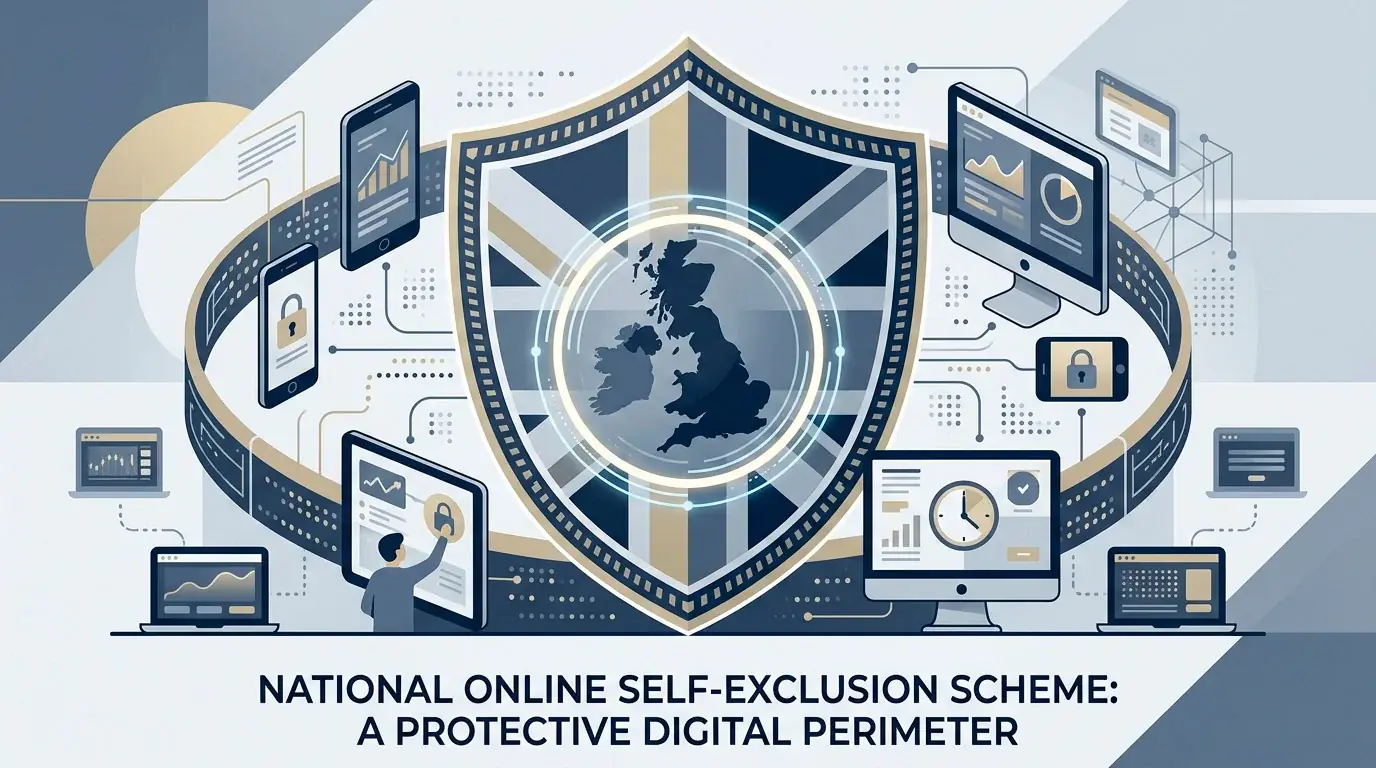
The phrase “casinos not on GamStop” is a marketing construction rather than a regulatory category. It describes online gambling operators that do not hold a licence from the United Kingdom Gambling Commission and are therefore not connected to the National Online Self-Exclusion Scheme run by NOSES, the National Online Self-Exclusion Scheme Limited. Because no integration exists with the GamStop database, an account application from a UK consumer is processed without any cross-check against the self-exclusion list. From the operator’s point of view it is a customer like any other. From the player’s point of view it is a site that lies entirely outside the protective fabric that UKGC builds around the regulated market.
Where do these operators sit, then? Almost always offshore, in jurisdictions whose licensing regimes are lighter than the UKGC. The dominant regime is Curacao, which since the Landsverordening op de Kansspelen (LOK) entered into force on 24 December 2024 has been moving to a stricter format with the Curacao Gaming Authority issuing licences as OGL/2024/####/#### and progressively retiring the older 1668/JAZ sub-licence model. Anjouan in the Union of Comoros operates a parallel offshore regime with the ALSI-####-#### format and has been gaining brands as Curacao tightens. Malta Gaming Authority sites also appear from time to time, but their UK exposure is usually accompanied by a UKGC licence, which would reconnect them to GamStop. The remaining licences a UK reader is likely to encounter are Kahnawake and Gibraltar, both of which tend to cooperate more closely with UKGC and rarely serve declared UK customers.
A reader who searches the phrase typically falls into one of two groups. The first group is in active GamStop self-exclusion and is looking for a way to gamble before the exclusion period ends. The second group is recreational, unhappy with the cumulative effect of UK reforms on UKGC sites, and is looking for higher deposit ceilings, faster bonuses, crypto deposits or a lighter on-ramp than UK affordability checks now allow. The two motivations sit uneasily together, and the editorial line of this site is to address both without endorsing either: the regulatory facts are the same in both cases, the trade-offs are the same, and a reader who has understood the page can decide for themselves where they stand.
Trace how the GamStop scheme sits inside UKGC rules
GamStop launched in April 2018 as the United Kingdom’s national multi-operator online self-exclusion scheme. It is operated by NOSES, the National Online Self-Exclusion Scheme Limited, and is funded by industry levy and operator fees. A UK consumer registers on gamstop.co.uk by providing their personal details and choosing an exclusion period of six months, one year or five years. From the moment the registration is processed the user is blocked from opening accounts at, or logging into, every online gambling site and app licensed by the UK Gambling Commission. Operators query the database and resynchronise their self-exclusion lists at least every 24 hours.

The scheme is mandatory for UKGC operators because of a specific licence condition. Since 31 March 2020 the Licence Conditions and Codes of Practice Social Responsibility Code 3.5.5 has required every UKGC-licensed online gambling operator to participate in GamStop. From 1 April 2024 the requirement was extended to telephone and email betting as well, as confirmed by the UK Gambling Commission’s published guidance on widening the scope of the scheme. The legal anchor sits in the wider statute: section 33 of the Gambling Act 2005 makes it a criminal offence to provide facilities for gambling in Great Britain without a Gambling Commission licence, which is what gives UKGC the leverage to attach LCCP conditions to every licence it issues.
The scope of GamStop is more limited than many readers assume. It covers online gambling, plus from 2024 telephone and email betting, but it does not block land-based betting shops or casinos, it does not block the National Lottery, and it does not block sites licensed outside the United Kingdom. This last point is the entire reason “casinos not on GamStop” exists as a search term. A GamStop registration prevents the user from opening or accessing accounts at UKGC sites for the chosen period. It does not, and was never designed to, prevent the user from finding and registering at an operator licensed in Curacao or Anjouan. That gap is acknowledged by the scheme itself, and when a registration period eventually ends, a player who wishes to use UKGC sites again must end the GamStop self-exclusion the official way through the 24-hour cooling-off process rather than rely on any shortcut sold by a third party.
The key takeaway on scheme mechanics
GamStop is enforced through LCCP 3.5.5 on UK-licensed operators. The scheme cannot reach an operator that holds no UKGC licence. That is a design feature of the licensing model, not a flaw in GamStop, and it explains the entire non-GamStop category in one sentence. A serious response to that gap is the TalkBanStop programme combining GamStop, Gamban and bank-level blocks, funded by the Gambling Commission.
The scheme continues to grow. GamStop’s own H2 2025 report records 58,675 new registrations in the second half of 2025, an average of 319 per day, taking the cumulative total above 562,000 since launch. The 16 to 24 age band accounted for 29 per cent of new sign-ups in that half-year and grew 40 per cent year-on-year. Those numbers matter because they define the pool of UK consumers who are, by their own choice, blocked from UKGC sites and who form the bulk of the reachable audience for any offshore brand actively marketing to British search terms.
Trace why some operators sit outside GamStop
The reason operators sit outside GamStop is simpler than it looks. GamStop participation is a UKGC licence condition, not a free-standing legal obligation. An operator who does not hold a UKGC licence cannot be made to integrate with GamStop because there is no licence to attach the condition to. UKGC’s enforcement reach is statutory and aimed at unlicensed operation in the UK market, but until an operator is identified, served and enforced against, it can continue to accept registrations from UK consumers without any contact point to the GamStop database. The result is a structural asymmetry between the regulated UK market, which is fenced by a self-exclusion scheme, and the offshore market, which is not.

There is a second layer to this. Why do operators choose to remain outside that perimeter at all, rather than apply for a UKGC licence and trade in the regulated market? The answer is commercial. UKGC licensees are bound by a long list of obligations that offshore licensees are not. Online slot stakes are capped at five pounds per spin for players aged 25 and over from 9 April 2025 and two pounds per spin for players aged 18 to 24 from 21 May 2025. Autoplay is banned. Bonus-buy features are disabled. Credit cards are banned from online gambling at UKGC sites since April 2020, after UKGC research found that 22 per cent of credit-card online gamblers were problem gamblers compared with 3.8 per cent of debit-card users. Frictionless financial vulnerability checks have been phased in. From 1 April 2026 the Remote Gaming Duty doubled from 21 per cent to 40 per cent on online casino-style products. Each of these is a cost or a restriction that offshore operators do not have to absorb, which is the lever by which they offer the bigger bonuses, higher stakes and lighter on-ramps that fuel the niche.
The Frontier Economics estimate commissioned by the Betting and Gaming Council places the size of the UK offshore audience at roughly 1.5 million adults. That number should be treated with caution because it is a sponsored estimate from a body whose members benefit from a tighter clampdown on the offshore market, but the direction of travel is corroborated by independent reporting: the offshore share of the UK market has been growing, and the regulatory tightening of the licensed market has been one of the principal drivers.
Read the legal status under the Gambling Act 2005
The single most important distinction in this entire topic is the difference between operator-side and player-side legal liability under UK law. The Gambling Act 2005 is operator-facing. Section 33 makes it a criminal offence to provide facilities for gambling in Great Britain without a licence. Section 36 extends that offence to remote gambling where the facilities are used in Great Britain, which means an operator located on a server in any jurisdiction commits an offence under UK law if it knowingly accepts customers in Britain without a UKGC licence. The Gambling (Licensing and Advertising) Act 2014 introduced the point-of-consumption principle on top of that, closing the previous loophole by which an operator based in a low-tax jurisdiction could serve UK customers without a UKGC licence so long as it did not advertise in the UK.

Player-side, the position is different. There is no equivalent criminal offence in the Gambling Act 2005 targeting an individual British player for placing a bet at an unlicensed offshore site. UK gambling law treats the player as a consumer, not a participant in the offence. That is the legal answer most affiliate articles either omit or muddle, and it is the legal answer that should sit at the top of any honest discussion of the niche. It does not, however, mean the player faces no consequences. The consequences attach through other channels: the absence of UKGC dispute resolution through IBAS, the absence of a minimum standard for player-fund segregation, the absence of GamStop coverage, the willingness of UK banks to decline transactions to offshore gambling merchants, and the willingness of UK banks to ask source-of-funds questions under the Money Laundering Regulations 2017 when offshore winnings hit a current account.
The enforcement story continues to evolve. On 23 February 2026 the Department for Culture, Media and Sport opened a consultation on banning unlicensed-operator sports sponsorship in the UK market, an extension of the existing operator-facing enforcement under section 33 of the Gambling Act 2005 and the related advertising provisions. The direction of travel is to tighten the screws on the operator and on the advertising and payment chain that surrounds the operator, rather than to begin pursuing individual players.
Compare offshore licence regimes after the 2024 LOK reform
An offshore casino licence is not a single category. The three regimes a UK player is most likely to encounter behave differently and produce different risk profiles. The Curacao regime was reformed on 24 December 2024 when the Landsverordening op de Kansspelen, the National Ordinance on Games of Chance, entered into force. The new licensing authority is the Curacao Gaming Authority, and new licences are issued in the OGL/2024/####/#### format. The older 1668/JAZ sub-licence model under master-licence holders is being phased out over a transitional period. The LOK introduced an “adequate” player-fund protection requirement, although the ordinance does not specify a minimum numerical reserve, which is one of the limits of the reform.

Anjouan in the Union of Comoros is the second regime. Licences are issued by Anjouan Gaming in the ALSI-####-#### format. Anjouan gained share through 2024 and 2025 because operators looking to escape the Curacao transitional friction had a ready alternative. Anjouan is the lighter of the two regimes in practice, and it is the licence most often seen on crypto-first sites with very short trading histories. The third regime, Malta Gaming Authority, is the most stringent of the offshore options, but pure non-GamStop MGA sites are rare for British players because MGA operators that serve UK customers will normally also hold a UKGC licence and would therefore be reconnected to GamStop. The remaining licences a UK reader might come across are Kahnawake in Canada and Gibraltar, but these jurisdictions cooperate closely with the UKGC and tend not to serve declared UK customers.
For a UK player the practical implication is that the licence sticker in the footer of the site is the start of due diligence, not the end of it. Two operators carrying the same OGL/2024 prefix can have very different complaint records, trading histories and ownership structures, and the licence alone tells you nothing about which of the two will pay out a withdrawal in three working days.
Assess safety, fund protection and dispute reality
The hardest part of this topic for a careful reader is what genuinely happens when a payout is delayed or refused at an offshore site. UKGC consumer protections do not apply. IBAS, the Independent Betting Adjudication Service, will not adjudicate a complaint against a non-UKGC operator. Curacao post-LOK has improved the language around player-fund protection but has not specified a numerical reserve. Anjouan has no comparable standard. Bank-side reversibility is limited because offshore operators typically push players towards e-wallets, vouchers and cryptocurrency precisely because UK card and bank rails are unreliable. Crypto withdrawals in particular cannot be reversed once they leave the platform, which removes the chargeback safety net entirely.

What offshore operators tend to offer
- Higher per-spin stake ceilings than the five pound UKGC slot cap
- Larger bonus structures and fewer bonus restrictions
- Direct acceptance of cryptocurrency deposits and withdrawals
- Lighter onboarding, often without an immediate KYC checkpoint
- Acceptance of payment methods that UKGC operators cannot or will not use, including credit cards in some cases
What you give up by leaving the UKGC perimeter
- GamStop coverage and the wider responsible-gambling stack built on top of UKGC licensing
- IBAS-equivalent independent dispute resolution
- UKGC’s minimum player-fund segregation language
- UK affordability checks designed to protect against escalating loss
- Chargeback safety net on crypto withdrawals once the transaction is settled
- Predictable bank-side support if a payment to or from the operator is disputed
There is a second risk that does not appear on most affiliate sites: re-targeting through sister brands. Several of the larger names in the niche are operated by groups that run multiple front-end brands under one corporate parent and one Curacao licence string. A player who self-excludes at one brand is not excluded from sister brands and can be re-onboarded with the same email and bank card. This is a structural feature of the licensing model rather than a defect of any one operator, but it converts a single point of self-exclusion into a perimeter the player has to police themselves across half a dozen lookalike sites.
Map the payment chain and UK bank blocks
Payments are where the offshore market collides hardest with the UK financial system. Every gambling card transaction carries the merchant category code 7995. UK banks read that code and most major issuers, including Monzo, Starling, Lloyds, NatWest, HSBC and Halifax, now offer an in-app gambling block with a 24 to 48 hour cool-down before it can be lifted again. Some issuers block offshore gambling merchants by default regardless of the customer’s gambling-block setting. The combination of those two layers is what produces the “card declined” experience that the niche has spent the last few years routing around.

The routing solution offshore operators use is a layered payment menu. E-wallets such as Skrill, Neteller, MiFinity and AstroPay sit between the player’s bank and the operator and convert what would have been a direct card-to-merchant transaction into a card-to-wallet load and a separate wallet-to-merchant transfer. Voucher methods such as PaysafeCard provide cash-loaded anonymity at the cost of withdrawal limits. Mobile wallet payments through Apple Pay and Google Pay can pass through the same blocks as the underlying card. The crypto layer, with Bitcoin, Ethereum, Litecoin, USDT, USDC, XRP, Dogecoin, Bitcoin Cash, Solana and Tron all routinely accepted, removes the bank entirely from the deposit transaction but creates a source-of-funds question at the bank when winnings eventually need to be cashed out in pounds.
That source-of-funds question is governed by the Money Laundering, Terrorist Financing and Transfer of Funds (Information on the Payer) Regulations 2017. UK banks are obliged to query suspicious inflows. Crypto-denominated gambling winnings landing in a UK current account are routinely flagged. A reader who has played on offshore platforms and is preparing to cash out should expect to be asked to evidence the source of the funds, and should not be surprised if the bank declines to credit them while the query is open.
For a more granular comparison of which methods clear which blocks, the dedicated page on payment methods accepted at non-GamStop casinos sets out the trade-offs by method. For the bank-side picture, the page on why UK banks block deposits to offshore casinos goes deeper into MCC 7995 and the issuer-by-issuer mechanics.
Cut through the no-KYC marketing claim
The “no KYC casino” claim is one of the most consistently misleading lines in the niche. In reality identity verification is rarely waived; it is deferred. Under Curacao LOK the operator is required to verify the player at points of material risk. Anjouan imposes a lighter standard but still allows the operator to demand KYC when it chooses to. Beyond the operator’s own obligations, the UK banking system applies the Money Laundering Regulations 2017 at the exit point, and the payment processor sitting between the player and the operator applies its own anti-money-laundering rules. A site that has not asked for identity at registration will usually ask for it the first time the player attempts to withdraw a meaningful sum.

The mechanism behind the documented complaints on casino.guru, AskGamblers and lcb.org is straightforward. Deposits are accepted without verification, sometimes without even a confirmed email address. Play proceeds. At the first withdrawal request the operator asks for a full KYC pack: photographic identity, proof of address, source-of-funds documentation, sometimes a selfie video. The verification is then either delayed by repeated requests for different document formats, or the account is closed for an alleged breach of terms that becomes visible only at this point. Variants of this pattern recur frequently enough that an offshore site that demands KYC only at the withdrawal stage should be treated as a flag rather than a convenience. The same goes for “bonus abuse” account closures applied retroactively to play that was within the published bonus terms at the time.
The defensive move for any reader who plays in this category is to complete KYC voluntarily before depositing significant sums, keep copies of every document submitted and every email response, and avoid bonuses with complex terms whose breach is hard to disprove. The dedicated page on KYC and identity verification at non-GamStop sites goes through this in more detail.
Run practical due diligence before you commit any money
If you have read this far and are still considering whether to use a site in this category, the responsible response is not a recommendation but a checklist. The seven steps below are the same steps a regulator-aware reviewer would run, none of them require specialist tools, and each of them surfaces one of the recurring risks documented in this guide. None of them guarantees a good outcome; together they raise the probability that you will not lose money to a site that was never going to pay you out in the first place.

- Check the licence and the regulator. Find the licence string in the footer. Verify it on the issuing regulator’s own site. For Curacao that is the Curacao Gaming Authority. For Anjouan it is Anjouan Gaming. For MGA it is the Malta Gaming Authority public register. An operator that does not show its licence in the footer is failing the very first check.
- Confirm the company entity. The footer should list a registered company name and address. Cross-check the company against independent review databases. If five front-end brands share one company name and one licence number, you are looking at a single operator family, not five competitors.
- Audit the complaint record. Search the brand name on casino.guru, AskGamblers and lcb.org. Pay particular attention to complaints about late KYC, withheld winnings and retroactive bonus-abuse closures.
- Read the bonus terms before, not after. Wagering requirement, maximum bet during wagering, eligible games, expiry, maximum win cap. A bonus you cannot satisfy at moderate stakes is a bonus designed to be forfeited.
- Test the support channel. Open the live chat before depositing and ask a substantive question. A site whose support cannot answer a payment question in plain English before you have given them money is unlikely to handle a complex withdrawal query well after.
- Complete KYC proactively. If the site lets you upload identity documents before depositing, do it. It removes the most common single point of failure at withdrawal.
- Plan the exit before the entrance. Decide before you deposit how you will withdraw, which UK account or wallet will receive the funds, and what you will do if the bank asks a source-of-funds question under the Money Laundering Regulations 2017. If you cannot answer those questions cleanly, do not deposit.
For deeper coverage of the licence verification step, the cluster page on how to verify an offshore casino licence and spot scam patterns goes through the UKGC public register and the equivalent regulator portals step by step. For the underlying licence regimes the page on Curacao, Anjouan and MGA licences compared after the 2024 LOK reform sits beside it.
Find help if your gambling is causing harm
If you are reading this page because gambling has stopped being a choice, or because you are tempted to seek non-GamStop sites while you are self-excluded, the most useful thing on this entire page is the contact information in this block. These services are free, confidential and independent of any operator.
- National Gambling Helpline (operated by GamCare): 0808 8020 133, free, 24 hours a day, 7 days a week. Live chat and WhatsApp via gamcare.org.uk.
- GambleAware: independent prevention and treatment information at gambleaware.org.
- GamStop: the national online self-exclusion scheme at gamstop.co.uk. Pair it with Gamban device-level blocking through the TalkBanStop programme so that the exclusion reaches offshore sites at the device layer.
- NHS National Gambling Treatment Service: clinical care across England, Scotland and Wales via nhs.uk.
Gambling is for adults of 18 and over. If you are in active GamStop self-exclusion, the safest next step is to call 0808 8020 133 rather than to read further about offshore alternatives.
About the author
Nathan Caldwell is a gambling-regulation researcher who has spent more than a decade analysing how UK self-exclusion schemes, licensing frameworks and offshore operators interact. His work centres on player-protection mechanisms, the GamStop scheme and the practical realities British players face when they encounter operators licensed outside the United Kingdom. He writes to help readers weigh the legal and safety trade-offs behind their gambling decisions rather than to promote any single operator. Over his career he has contributed analysis to industry compliance discussions and completed certified training in responsible-gambling practice. Full author page.
Common reader questions answered
Are casinos not on GamStop legal in the UK?
UK gambling law is operator-facing. Under sections 33 and 36 of the Gambling Act 2005, providing remote gambling facilities to customers in Great Britain without a UK Gambling Commission licence is a criminal offence for the operator. There is no equivalent criminal offence in the Act that targets the individual British player for placing a bet at an unlicensed offshore site. However, the player loses UKGC consumer protections and faces practical risks including bank-side payment blocks and source-of-funds queries under the Money Laundering Regulations 2017.
Can a self-excluded player register at a non-GamStop casino?
Technically yes, because offshore operators do not connect to the GamStop database. This is the central harm-reduction concern around the niche. A GamStop self-exclusion does not block accounts at sites licensed outside the UK. Players in active self-exclusion who feel tempted to seek non-GamStop sites should contact the National Gambling Helpline on 0808 8020 133 and consider Gamban device-level blocking via the TalkBanStop programme, which is designed to cover exactly this gap.
Do non-GamStop casinos really require no KYC?
The marketing claim of “no KYC” is misleading. Under Curacao licensing reforms, Anjouan rules and UK anti-money-laundering rules applied to banks and payment processors, identity verification is typically deferred rather than waived. Sites commonly request verification only when a player attempts to withdraw, which is the mechanism behind the documented delayed KYC trap pattern.
Why do UK banks block deposits to non-GamStop casinos?
Card transactions to gambling merchants carry the merchant category code 7995. Most major UK banks including Monzo, Starling, Lloyds, NatWest and HSBC offer an in-app gambling block with a 24 to 48 hour cool-down before it can be lifted again. Some issuers go further and block offshore gambling merchants by default, which is why offshore operators steer players towards e-wallets, vouchers and cryptocurrency.
What licence do most non-GamStop casinos hold?
The dominant licensing jurisdictions are Curacao, since the Landsverordening op de Kansspelen took effect on 24 December 2024 with the new Curacao Gaming Authority issuing licences in the OGL/2024/####/#### format, and Anjouan in the Union of Comoros with the ALSI-####-#### format. Malta Gaming Authority licences appear less frequently because MGA operators serving UK customers usually also hold a UKGC licence and would therefore be reconnected to GamStop.
How do I check whether an offshore casino’s licence is genuine?
The UK Gambling Commission public register at gamblingcommission.gov.uk lists every UKGC-licensed operator with status fields including Active, Suspended, Revoked and Surrendered. Curacao licences can be verified on the Curacao Gaming Authority site at cga.cw. Anjouan licences can be verified with Anjouan Gaming. Operators that still display a legacy 1668/JAZ Curacao logo without a current OGL/2024 number warrant additional scrutiny following the LOK transition.
What help is available if I am struggling with gambling in the UK?
The National Gambling Helpline operated by GamCare is available on 0808 8020 133, free, 24 hours a day, 7 days a week, with live chat at gamcare.org.uk. GambleAware funds prevention and treatment services across England, Scotland and Wales. GamStop at gamstop.co.uk provides the national online self-exclusion scheme, and the TalkBanStop programme pairs it with Gamban device-level blocking software. The NHS National Gambling Treatment Service offers clinical care.
Published by the Casino not on Gamstop team.